Sheffield's craft cutlery industry surviving today
By Will Dixon
Steven Cocker fitting blades into a pocket knife in his Sheffield workshop (Video: Steven Cocker, with permission)
Sheffield's craft cutlery industry surviving today
To modern eyes, Sheffield appears a curious choice to place a major manufacturing centre. There were neither great amounts of iron ore below ground, nor good trade routes above, as great hills penned the place in.
Yet the Sheffield of the 17th century began to outcompete London, its blade-making rival, because it had a supply of fast-running water, sand and coal. Those resources proved the trade’s real constraints, needed to cast and harden steel, to grind and polish them; it was, essentially, the stuff that gave Sheffield and its blades the edge.
Censuses show in the 1600s around three in five working men in the town were in the cutlery trade. The Earl of Shrewsbury, the local noble, who was in charge of regulating the trade, found it took up too much of his time. Local cutlers persuaded parliament to let them regulate their own affairs. They passed legislation allowing for a Company of Cutlers in Hallamshire to be created.
Act of parliament (public domain)
Act of parliament (public domain)
The new company formalised how cutlers would be trained. They held a large list of stamps, the equivalent of modern-day trademarks, that freemen of the company were entitled to impress on their wares. Only stamped goods could be sold legally.
To become a freeman budding cutlers would have to apprentice with an existing cutler, usually for seven years. They would then have to prove that he had enough money to buy the raw goods, which normally entailed working as a journeyman for a few years more.
The company’s official history said: “boys (and it was always boys) were not usually apprenticed until they were at least twelve years-old… and [the apprenticeships] could not be completed until the boy had reached the age of twenty-one”.

A folding knife with a file produced by J. Adams Ltd, a knifemaking firm that spanned six generations. (Photo used with permission of the Ken Hawley Trust.)
A folding knife with a file produced by J. Adams Ltd, a knifemaking firm that spanned six generations. (Photo used with permission of the Ken Hawley Trust.)

A horseman's knife produced in the mid-19th century by Henry Bramall, a Sheffield cutler. (Photo used with permission of the Ken Hawley Trust.)
A horseman's knife produced in the mid-19th century by Henry Bramall, a Sheffield cutler. (Photo used with permission of the Ken Hawley Trust.)

A pen knife marked 'H. Deakin', for which records no longer remain. (Photo used with permission of the Ken Hawley Trust.)
A pen knife marked 'H. Deakin', for which records no longer remain. (Photo used with permission of the Ken Hawley Trust.)
How a knife is made
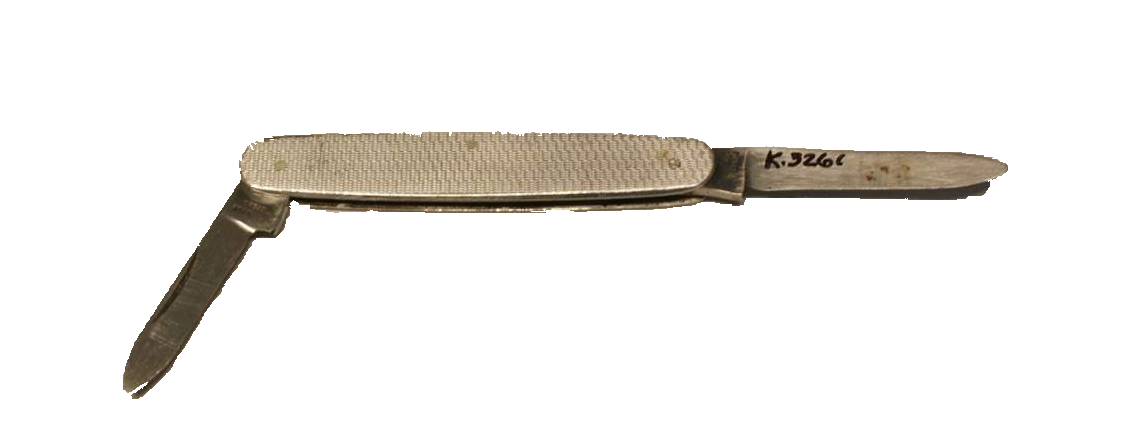
Blades were traditionally forged from high-carbon steel, but now are forged from stainless grades. Though some now choose to stamp or laser-cut the blades, the traditional method is for them to be shaped using a hammer and press.
(Photo used with permission of the Ken Hawley Trust.)
The blade is ground on a wheel or belt to form bevels, the skill of the grinder means they can use their eye to grind them out on ever finer abrasive wheels.
The blade is then heat treated to harden it, then tempered at a lower heat to remove brittleness. Some knife makers outsource this step.
The springs for the blade are cut from spring steel, and are shaped and filed by hand. They are also tempered to hold the blade open or shut with the right tension and without wobble. The knife maker will ensure the blade closes flush, and that they click into place by resting on the tension of the spring.
Sometimes metal caps are added at the end of, and the knives are lined with metal plates. Handles are often made of brass, nickel or steel.
Pins and rivets hold the knife together and are what the blade will pivot around.
The scales are made of bond, bone, stag horn, wood, mother-of-pearl, micarta or acrylic. They will be hand-cut, shaped and then drilled to the frame.
A decline in the cutlery trade
Knife manufacturing in South Yorkshire is still heavily centred around the city centre, where it started. One knife maker, Michael May, has his workshop in the Portland Works, where Harry Brearley developed stainless steel for cutlery use over a century ago.
Employment figures from the boom-time show how the industry peaked in the early 20th century, where Sheffield was sustained by a strong domestic marked, and exports, largely to the United States.
“The boom lasted from around 1913 or 1914 until the start of the Second World War. Over that period there was in excess of 1,500 companies that were either making or selling table knives," said Nick Duggan, a local curator and collector.
Though there used to be hundreds of small makers there are now only eleven firms counted by Peter Machan, author of The Little Mesters: The Rise, Decline and Survival of Sheffield's Traditional Trades as working in the industry. Some are sole traders and others only employ a handful of people to work within the firms (see above map).
Modern employment statistics for Sheffield also tell a similar story. The industry declined in the 1970s as South Korea and Germany were able to produce cheaper products for the mass market.
Though niche markets remain, many of the craftsmen have died. For instance, blades are no longer hand forged after the last one, Stuart Truelove, died in 1997 without an apprentice.
Meet the makers
Steven Cocker, 40, has lived in Sheffield and has made knives most of his life.

Steven Cocker
Steven Cocker
His father, Ernest, was a French polisher, and rented a workshop in the back of Joseph Elliot’s, a Victorian cutlery factory on Sylvester Street in Sheffield’s city centre.
It was there that Cocker used to watch other craftsmen in their little workshops.
“I used to go every school holiday,” he said. “There were still some of the old ‘little mesters’ of the time, there were scissor makers, knife makers, hand forgers, hand grinders. It was like a look back in time and I just fell in love with it.”
He made his first knife aged nine, with a three-inch lambfoot blade and polished, rosewood scales.
“The old cutlers down at the works, they gave me loads of old parts, and we just put it together. I was just dead pleased with it,” he said.
He worked for Trevor Abblet, an older knifemaker on Saturdays throughout school.
When he was finishing school in 2002, his careers teacher encouraged him to join the industry and told him to write to the knife making firms with a reference from Abblet.
“Egginton Brothers got back in touch with me. And when I left school, I went to do an apprenticeship there," he said.
“I went to work there when I was 16 and it was like an old fashioned apprenticeship,” he said, learning from Pete King and Ken Law, both cutlery grandees.
Currently recovering from heart surgery, he works for Durham Duplex, which recently brought Eddington Brothers, owners of the Joseph Rodgers brand, which was first granted its trademark in 1682.
Cocker is particularly fascinated by the pattern books kept by the old firms, specifying how to make their own knives.
"They are really big ledgers where somebody has sat and drawn every pattern," he said.
"There's a description of the knife and it's all in like fancy Victorian handwriting, and some are dated and then some are who they were made specially for.”
He can make around ten normal knives per week, though if he’s making a larger knife, that can take him a little longer.
Knives were once sold to hardware and department stores, but now many of them sell them directly to the customer, at Sheffield’s museums, or online through Instagram.
Steven Cocker's show knife commissioned by the Ken Hawley Trust (Image: Steven Cocker)
Steven Cocker's show knife commissioned by the Ken Hawley Trust (Image: Steven Cocker)
Michael May, 47, has made similar knives for over twenty years.
He studied music at college and didn’t want to go to university, getting a job instead in Taylor's Eye Witness' pen and pocket knife department.
“It was all done in-house pretty much, like a proper factory, and then I think some of their bigger contracts started drying up and things started moving to the Far East,” he said. At one point, there was only one person in the department working three days a week.
He has been working for himself for a decade and he finds that a lot of people choose to buy his knives after seeing him working on Instagram: “I have to do everything and trying to also remember to put out content there as well, it's quite hard. And when you've done it for so long you don't really think too much about what you do is interesting to other people.”
“I have trained someone in the past, but then there wasn't enough work for the two of us, but he decided to leave and go to university anyway. If I took on an apprentice now, I've already got such a backlog, it'd just be almost impossible to put the time in.”
Making history
Nick Duggan, a retired Geography teacher, is a volunteer at the Ken Hawley Trust, the largest tool collection in Europe. Over one-hundred-thousand pieces of cutlery, flatware and tools were collected by the eponymous former tool shop owner, many of which have been catalogued and photographed online.
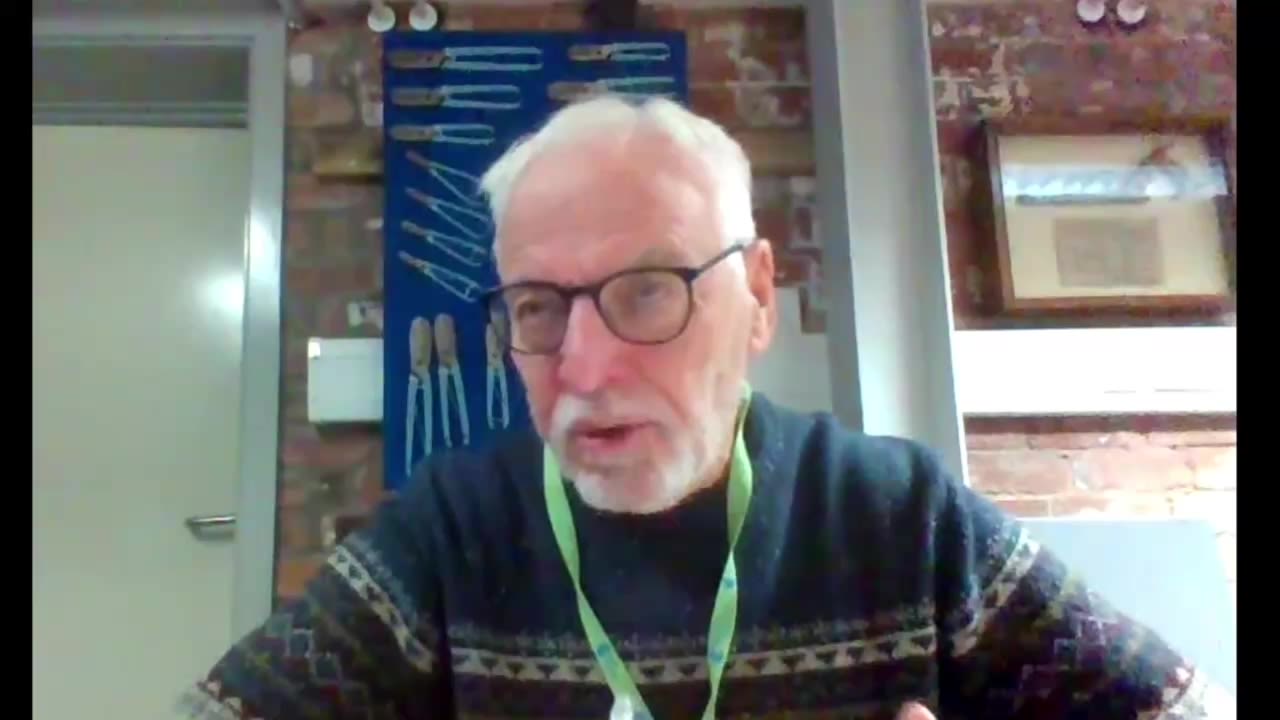
Nick Duggan
Nick Duggan
What does he think a "little mester" is? “A craftsperson probably doing a single job and feeding into the system. As somebody who is probably working in a grotty, congested, messy workshop but actually turning out things of fabulous beauty or fabulous skill,” he said.
“It’s remarkable that Sheffield, the most landlocked place in the country more or less, was exporting essentially metal goods which are heavy all over the world.
“The thing that endures throughout all this is the skill of the craftspeople.”
Emma Paragreen is the archivist and curator for the Company of Cutlers.

She was quick to point out the difference between cutlery – that with a cutting blade – and flatware like spoons and forks.
“Although we don't regulate the cutlery industry anymore, we do take in freemen and we do take in people that are associated with the cutlery industry," said Paragreen.
Although cutlery making is on Britain's heritage risk register, she pointed out that Sheffield's heavy industry is booming, as shown in the Company's leadership.
“The current master cutler works for Forgemasters, who's just got the MOD contract for huge large scale steelworks in Sheffield. The past master, he worked within surgical instruments, hip joints and worked globally. The master before him was Charles Turner and owns Durham Duplex and some heritage knife making brands,” she said.
Training the next generation
Charles Turner, 60, owns Durham Duplex, a firm that largely produced cutting edges for industry. After a spell as Master Cutler, he bought the hand knife division of Egginton Brothers, which included some of the city’s oldest brands.
He employs four members of staff who rent and work in a shop in the Kelham Island Museum, who make knives by hand in front of the public, including Steven Cocker and his wife, Kylie.
Spike Collins, 23, has been making knives for five years as one of only a handful of knifemakers in Sheffield under 30. He works in the museum.
Leaving school at 18, he got a job at a supermarket. One of his colleagues who had a relative at Eggintons suggested he apply for a job there.
Though it was not a formal apprenticeship, he was taught by Cocker, and can make a smaller knife himself.
“He'll show me how to do something and I'll do that for all of that batch of knives,” said Collins. “He just teaches you each step and you just pick it up sort of as you go.”
The main constraint on hiring new people is being able to afford to keep them, not lack of enthusiasm. Some young people have come up to him at trade shows and at the workshop and asked him about his job.
“It's just finding the time to train people – and you've got to pay them a wage,” he said.
Alongside the workshop in Kelham, Turner's factory usually has four to six people making industrial knives for the Army. Elsewhere in the company they have hired around eight young people in more formal apprenticeship schemes.
“You've got two aspects: the heritage side of beautifully made, handmade knives that are collectors items and then the other side are the items with an industrial application which we're making for the MOD and industry,” he said.
Turner is also keen to change the perception of knives: “People think all knives are dangerous but actually knives are only dangerous in the wrong hands.
“I know a lot of people who use them for peeling their apples and they carry them in their handbag all the time because it's a useful thing for apple peeling and stuff like that - so they are practical tools”
 Built with Shorthand